
Economic slowdown drives mixed reporting season
Many Australian companies are still battling economic crosswinds and headwinds.

.
Hundreds of companies listed on the Australian Securities Exchange (ASX) have just finished announcing their financial results from the full and half-year period to 30 June, 2024.
And the results were compelling, because they showed how different companies were able to deal with the economic crosswinds and headwinds that have been whipped up around them from the combination of rising inflation and higher interest rates.
For many companies, subdued consumer demand (reflecting reduced discretionary spending) resulted in weaker sales and operating margins, and ultimately lower earnings, in the last financial year. It was a similar scenario for many mining companies contending with depressed commodity prices and lower demand.
But other companies were actually able to thrive during the conditions. They reported stronger earnings due to higher demand for their products and services, which led to increased cash flows and profit margins.
Some companies were able to announce higher dividend payouts, but at the cost of using more of their profits to do so.
On aggregate results were weaker than expected, with earnings down 4.4% in the last financial year.
Among Australia’s top 200 companies, 16% missed earnings expectations for the 2023-24 financial year and also had consensus earnings downgrades for the 2024-25 financial year.
Understandably, given the current economic conditions, many companies provided cautious outlooks on the year ahead.
🚩Vanguard believes that if inflation returns to more sustainable levels, Australia’s slow growth will open the door to monetary policy easing.
Joining the economic dots
The latest corporate reporting season officially ended on 30 August, and last week the domestic economic data largely underpinning those results was released by the Australian Bureau of Statistics (ABS).
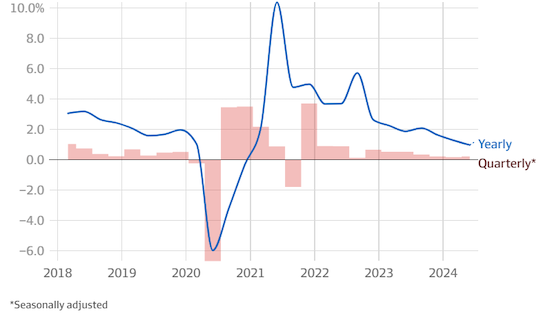
The ABS data showed the Australian economy had grown by a modest 0.2% over the three months to 30 June, and to 1.5% over the full 2023-24 financial year.
While this was the eleventh consecutive quarter of GDP growth, it was the sixth consecutive quarter of GDP per capita falls.
Real GDP growth
Expenditure-based
Source: Australian Bureau of Statistics, Bloomberg
While the ABS data showed that underlying inflation had continued to fall over the June quarter, the annual inflation rate was 3.8% higher than at the end of the June quarter of 2023.
“Excluding the COVID-19 pandemic period, annual financial year economic growth was the lowest since 1991-92 - the year that included the gradual recovery from the 1991 recession,” the ABS noted.
Spending on many discretionary categories fell in the June quarter. The strongest detractor from growth was transport services, particularly reduced air travel.
Furnishings and household equipment rose by 4% as households took advantage of end-of-year sales. This was partly offset by a 1% fall in food sales with households spending less on groceries.
Vanguard Senior Economist, Grant Feng, says lacklustre GDP growth suggests that restrictive monetary policy has curbed demand. However, the supply side has been weak too, which has discounted the impact of demand on inflation.
Yet Feng says low productivity growth has kept unit labour costs growing at a rate well above that which is consistent with the 2%–3% inflation target set by the Reserve Bank of Australia (RBA).
As such, the RBA may be one of the last developed markets central banks to ease monetary policy.
Vanguard believes that if inflation returns to more sustainable levels, Australia’s slow growth will open the door to monetary policy easing.
“Despite sticky inflation, we don’t foresee a rate hike by the RBA, whose dual mandate is to promote price stability and economic growth” Feng adds.
Important information and general advice warning
Vanguard Investments Australia Ltd (ABN 72 072 881 086 / AFS Licence 227263) is the product issuer and the Operator of Vanguard Personal Investor. We have not taken your objectives, financial situation or needs into account when preparing this article so it may not be applicable to the particular situation you are considering. You should consider your objectives, financial situation or needs, and the disclosure documents for any financial product we make available before making any investment decision. Before you make any financial decision regarding Vanguard products, you should seek professional advice from a suitably qualified adviser. A copy of the Target Market Determinations (TMD) for Vanguard's financial products can be obtained at vanguard.com.au free of charge and include a description of who the financial product is appropriate for. You should refer to the TMD before making any investment decisions. You can access our IDPS Guide, PDSs, Prospectus and TMDs at vanguard.com.au or by calling 1300 655 101. Past performance information is given for illustrative purposes only and should not be relied upon as, and is not, an indication of future performance. This article was prepared in good faith and we accept no liability for any errors or omissions.
© 2024 Vanguard Investments Australia Ltd. All rights reserved.
September 2024
Tony Kaye, Senior Personal Finance Writer
vanguard.com.au
Tony Kaye, Senior Personal Finance Writer
vanguard.com.au
Hot Issues
- Five steps towards a more confident retirement
- Financial literacy in Australia: Where we're improving (and falling behind)
- CSLR levy on SMSFs unfair
- SMSF pension shortfall – when can trustees self-assess?
- How to turn your annual SMSF investment strategy review into a genuine analytical exercise
- Super viewed as mortgage solution
- Tokenisation to change SMSF landscape
- Check out the largest castles by country
- ATO’s LRBA data significantly less than industry figures
- New deeming thresholds could deliver small part age pension
- Can I still get the Age Pension if my super is healthy?
- New to SMSFs? Start preparing for your first SAR lodgment
- Contribution splitting now more valuable
- Six ways Gen X can build retirement savings
- How to maximise the impact of your inheritance
- How Our Diets have Changed.
- Adequate retirement savings misjudged
- The SBSCH will close from 1 July 2026
- Complications of maintaining two cost bases in Div 296
- What the Payday Super changes mean for your retirement
- investment and economic outlook 2026
- Rules apply to gifting in superannuation
- Record SMSF growth driven by digital access
- The evolution of the world's languages
- Minimum pension drawdown not the only thing to consider as 30 June approaches
- ASIC urges Aussies to check for unclaimed money
- PAYDAY SUPER STARTS 1 JULY 2026 – Planning guides
- Commercial v residential: Be aware of ‘nuanced’ changes
- Six strategic investment moves for mid-career women
- Your 30 June superannuation checklist
- What’s your risk profile?
- Check out what Uses the Most Internet Traffic: Data from 1994 to 2026
Article archive
- April - June 2026
- January - March 2026
- October - December 2025
- July - September 2025
- April - June 2025
- January - March 2025
- October - December 2024
- July - September 2024
- April - June 2024
- January - March 2024
- October - December 2023
- July - September 2023
- April - June 2023
- January - March 2023
- October - December 2022
October - December 2024 archive
- Women still outpacing men in SMSF establishments
- Economic and market outlook for 2025: Global summary
- Preparing to lodge quarterly January TBAR
- How to overcome your investment fears
- Navigating the outcome of the U.S. election
- Divorce doesn’t alter contribution rules
- $3m super tax officially abandoned for this year
- Top 20 Most Watched Christmas Movies ever - pre covid
- A Unique Advent Calendar
- ATO reviewing all new SMSF registrations to stop illegal early access
- Compliance documents crucial for SMSFs
- Investment and economic outlook, October 2024
- Leaving super to an estate makes more tax sense, says expert
- Be clear on TBA pension impact
- Caregiving can have a retirement sting
- The biggest assets growth areas for SMSFs
- 20 Years of Silicon Valley Trends: 2004 - 2024 Insights
- Investment and economic outlook, September 2024
- Economic slowdown drives mixed reporting season
- ATO stats show continued growth in SMSF sector
- What are the government’s intentions with negative gearing?
- A new day for Federal Reserve policy
- Age pension fails to meet retirement needs
- ASIC extends reportable situations relief and personal advice record-keeping requirements
- The Leaders Who Refused to Step Down 1939 - 2024